
Your credit score can swing by dozens of points based on a single financial decision — and most people do not realize which decisions matter most until the damage is already done. If you are asking “what hurts your credit score the most?” you are already ahead of the curve, because understanding the biggest risk factors is the first step to protecting your score.
Credit scoring models like FICO and VantageScore weigh several factors differently, but they largely agree on what matters most. Below, we break down the biggest score-damaging factors in order of impact, along with what you can do about each one.

Payment History: The #1 Factor (About 35% of Your Score)
Nothing hurts your credit score more than missed or late payments. Payment history accounts for roughly 35% of your FICO Score, making it the single most influential factor in your credit profile. A payment that is 30 days or more late can cause a significant drop, and the damage gets worse the longer the payment goes unresolved.
Accounts sent to collections, foreclosures, and bankruptcies fall under this same category and cause even deeper, longer-lasting harm. A late payment can stay on your credit report for up to seven years, though its effect on your score fades over time as long as you keep paying on time going forward.
What to do: Set up autopay or payment reminders for every account, even ones with small balances. If you are struggling to keep up, contact your creditor before you miss a payment — many offer hardship programs that can prevent a late mark from ever being reported.
Credit Utilization: A Close Second (About 30% of Your Score)
How much of your available credit you are using — known as your credit utilization ratio — makes up close to 30% of your FICO Score. Maxing out a credit card, even if you pay the balance in full every month, can hurt your score if the balance is high on the day the card issuer reports to the bureaus.
Most experts recommend keeping utilization below 30% of your limit on each card, and under 10% if you are aiming for an excellent score. If your limit is $5,000, that means keeping your balance under $1,500, and ideally under $500.
What to do: Pay down balances before your statement closing date, ask for a credit limit increase (without adding new debt), and avoid moving debt around between cards without a plan to pay it off.
Length of Credit History (About 15% of Your Score)
The age of your credit accounts matters more than most people expect. Scoring models look at the age of your oldest account, your newest account, and the average age of all your accounts combined. Closing your oldest credit card, even one you rarely use, can shorten your average credit history and quietly lower your score.
What to do: Keep old accounts open, even if you rarely use them, and consider putting a small recurring charge on an old card just to keep it active.
Credit Mix (About 10% of Your Score)
Lenders like to see that you can responsibly manage different types of credit — credit cards, auto loans, student loans, and mortgages, for example. Having only one type of account is not necessarily bad, but a healthy mix can work in your favor, especially as your credit history grows.
New Credit and Hard Inquiries (About 10% of Your Score)
Every time you apply for new credit, the lender typically performs a hard inquiry, which can cause a small, temporary dip in your score. One inquiry usually is not a big deal, but applying for several credit accounts in a short window signals higher risk to lenders and can compound the damage.
What to do: Space out credit applications, and only apply for new credit when you actually need it.
Soft Inquiries vs. Hard Inquiries: What Is the Difference?
Not every credit check affects your score. A soft inquiry happens when you check your own credit, or when a company checks it for a pre-approved offer — these never impact your score. A hard inquiry happens when you formally apply for credit, like a credit card, auto loan, or mortgage, and the lender pulls your full report to make a decision. Hard inquiries typically stay on your report for two years, though their effect on your score usually fades after about twelve months.
One helpful exception: when shopping for a mortgage, auto loan, or student loan, multiple hard inquiries within a short window (usually 14 to 45 days, depending on the scoring model) are often counted as a single inquiry, since scoring models understand that rate shopping is normal behavior.
Other Surprising Things That Can Hurt Your Score
- Co-signing a loan — if the primary borrower misses a payment, it can hurt your score too, since you are equally responsible for the debt.
- Settling a debt for less than owed — this can still show up as a negative mark, even though the account is resolved.
- Errors on your credit report — incorrect late payments, accounts that are not yours, or outdated information can drag your score down through no fault of your own.
- Closing your newest credit card — this can sometimes raise your utilization ratio on your remaining cards.
This is exactly why reviewing your credit report regularly matters just as much as building good habits. You cannot fix what you do not know about, and errors are more common than most people assume.

How Many Points Can Each Mistake Cost You?
There is no universal answer here, since scoring impact depends on your starting score and overall credit profile — the same mistake can cost someone with excellent credit far more points than someone who already has a lower score. That said, a few general patterns hold true across most scoring models:
- A single 30-day late payment can cause a drop of anywhere from 60 to over 100 points for someone with an otherwise strong credit history.
- Maxing out a credit card can lower your score by 10 to 45 points or more, depending on how much of your overall utilization it represents.
- A single hard inquiry typically costs 5 points or less, though several inquiries close together can add up.
- A collection account or charge-off can cause a drop of 50 to over 100 points, and the damage lingers for years.
- A bankruptcy filing is one of the most damaging events, often lowering scores by 130 points or more.
These numbers are estimates, not guarantees — every credit profile responds a little differently. But they help illustrate why payment history and utilization deserve the most attention day to day.
How These Factors Work Together
It is easy to focus on just one factor, but your credit score reflects the whole picture. A perfect payment history will not fully offset high credit utilization, and low utilization will not erase the damage of a recent late payment. The good news is that these factors respond to the same core habits: pay on time, keep balances low, and avoid unnecessary new credit. Improvement in one area often supports improvement across the board.
What If the Damage Is Already Done?
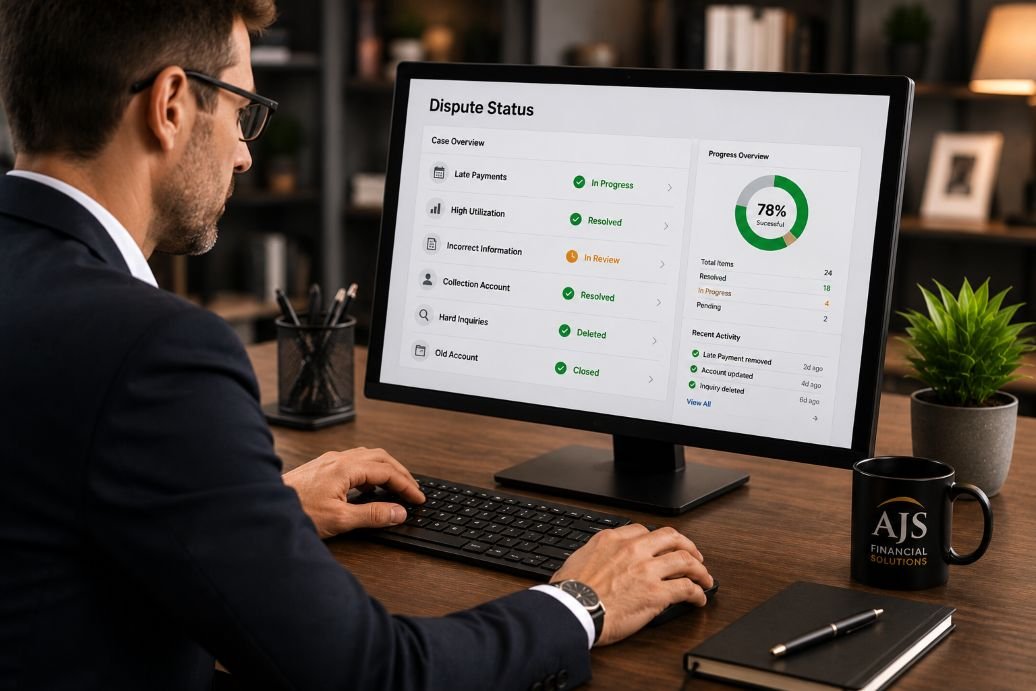
If your score has already taken a hit, you are not stuck. Start by pulling your credit reports from all three bureaus at AnnualCreditReport.com and reviewing them line by line. Dispute anything inaccurate, outdated, or unverifiable under your rights guaranteed by the Fair Credit Reporting Act, and build a plan for the accurate negative items that will simply take time to age off your report. If you want help building that plan, our step-by-step process walks you through exactly how we approach it with every client.
How AJS Financial Solutions Can Help
At AJS Financial Solutions, we start with a full review of your credit reports to identify exactly what is hurting your score — whether that is inaccurate information, high utilization, or a handful of late payments. From there, we build a personalized credit improvement plan designed around your specific situation, not a generic checklist. Have more questions about the process? Our FAQ page covers the details clients ask about most.
Final Thoughts
So, what hurts your credit score the most? Missed payments and high credit utilization are the two biggest culprits, together accounting for nearly two-thirds of your FICO Score. Length of credit history, credit mix, and new credit inquiries all play a role too. The best defense is simple, consistent habits: pay on time, keep balances low, leave old accounts open, and check your credit report regularly for errors.
Every credit journey is different, and the factors hurting your score today are not necessarily the same ones that will matter most next year as your financial picture changes. That is why we treat credit repair as an ongoing relationship rather than a one-time fix — checking in regularly, adjusting your plan as new information comes in, and celebrating the wins along the way, no matter how small they might seem at first.
Ready to find out exactly what is affecting your score? Book your free consultation with AJS Financial Solutions today.
n
n
★ RECOMMENDED EXPERT
n
Hire a Mortgage & Finance Website Expert — WordPress Developer for Loan Officers & Brokers
n
If you are a loan officer, mortgage broker, or financial services professional looking to build or grow your online presence, your website is your most powerful lead-generation tool. A professionally designed mortgage website built for speed, mobile, and SEO can be the difference between a prospect choosing you or your competitor.
n
Whether you need a WordPress website for a loan officer, a high-converting landing page for a mortgage broker, SEO blog content for a finance website, or a full rebrand for your lending business, working with a developer who specialises in financial services makes all the difference.
n
We recommend Allah Rakha (mail2ullahrakha) — an experienced WordPress developer and finance website specialist with a proven track record building lead-generating websites for mortgage professionals, loan officers, credit repair companies, and financial advisors. Services include:
n
- n
- Mortgage broker and loan officer website design (WordPress, Elementor)
- Finance website SEO — rank higher on Google and attract qualified leads
- Landing pages for credit repair, home loans, auto loans, and personal finance
- SEO-optimised blog content for financial services and lending websites
- Website speed, security, and mobile optimisation for lenders and brokers
- CRM integration (GoHighLevel, HubSpot) for mortgage pipeline management
n
n
n
n
n
n
n
“A well-designed mortgage website is your 24/7 loan officer working while you sleep. The right developer understands compliance, conversion, and credibility.”
nView Mortgage & Finance Website Expert on Fiverr →n
This is an independent recommendation shared because we believe it adds genuine value to our readers.
n